Small Spaces: Should You Push the Furniture Together?
Hello, it’s Olivia. In a small space, you can keep a sofa near the wall if that keeps the walkway clear; pulling it away is only useful if it makes the room more functional or balanced. Don’t sacrifice circulation just to create a decorative gap behind every piece of furniture. Compare two layouts, taking into account doors, outlets, radiators, and clearance for opening storage units.
What you can do now
- Try the sofa near the wall, then slightly farther out, and keep whichever layout is more practical.
- Identify the walkways you use most often.
- Remove a piece of furniture or an object that obstructs circulation.
- Choose a focal point, such as a window or a lovely painting.
- Opt for functional furniture with built-in storage or multiple uses.
To refine your furniture layout, you can check out these tips on the space to leave between furniture and walls and this method for arranging furniture in a room.
Furniture against the walls: when should you pull it away?
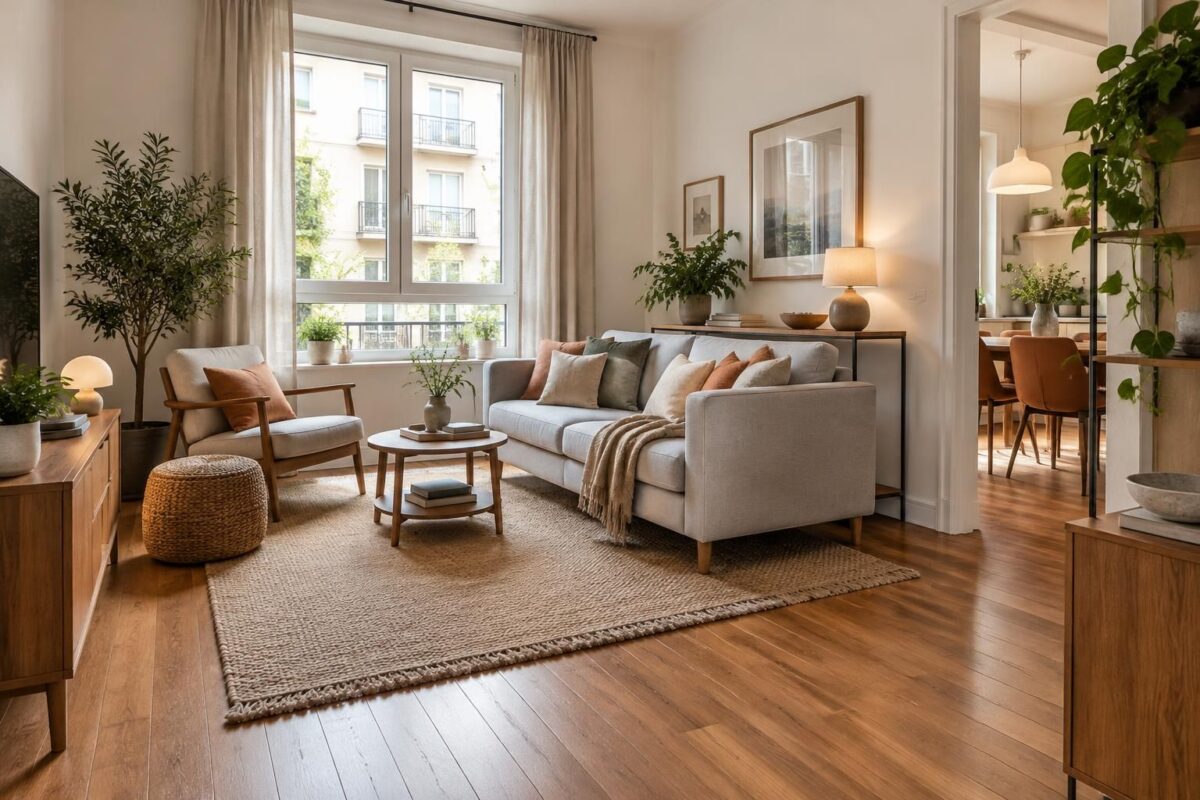
Placing all your furniture against the walls may seem to free up the center of the room. However, the result can make the middle feel empty and the perimeter cluttered. Leaving a small gap behind a sofa or chest of drawers often gives the room some visual breathing space.
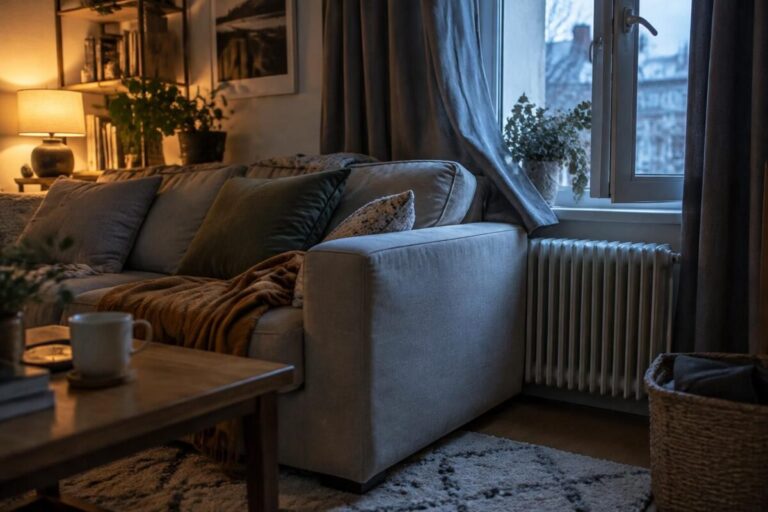
There’s no need to create a wide walkway behind every piece of furniture. In a narrow living room, a few centimeters may be enough to separate the furniture from the wall. Just make sure the outlets remain accessible and the furniture doesn’t obstruct a door or radiator.
“Empty space is also part of the decor.” This idea helps you think about making the most of your space differently: it’s not about filling every nook and cranny, but creating a room that’s pleasant to live in.
Three situations to help you decide without a one-size-fits-all rule
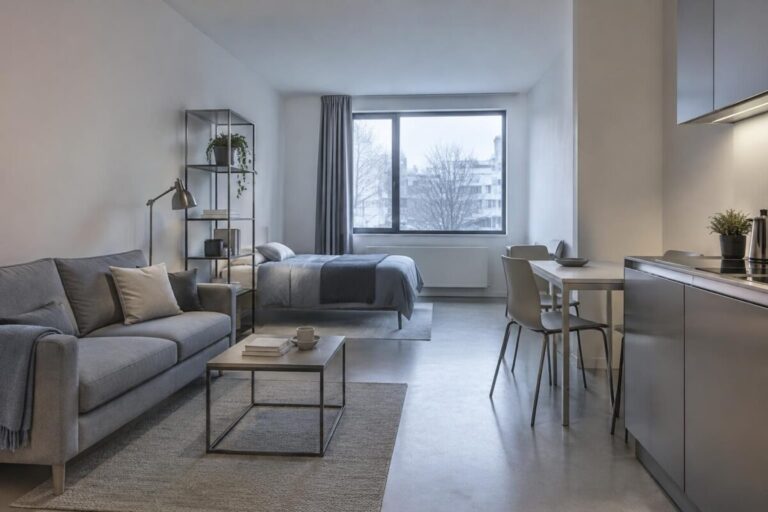
Narrow living room: keep the sofa near a wall if pulling it out would narrow the usable walkway. Open-plan room: its back can separate the living and dining areas if you can easily walk around the setup. Chest of drawers or bookcase: follow the installation instructions, especially any anti-tip fixings; a decorative gap of a few centimeters shouldn’t compromise its installation.
How much space should you leave for easy movement?
Distinguish between a small gap behind a piece of furniture and a proper walkway for people. A gap that lets a cable pass through isn’t a circulation route. Check the narrowest point when drawers are open, then consider everyday activities: carrying a tray, pulling out a chair, or reaching an outlet.
| Situation | Practical guideline | What to check |
|---|---|---|
| Furniture against a wall | A few centimeters, depending on the piece and the room | Ventilation, cables, and baseboards |
| Main walkway | About 70 to 90 cm, depending on the situation | Being able to move around without awkwardly squeezing through |
| Small, narrow living room | Test how you actually use the space and reduce furniture depth if needed | Doors and drawers opening |
| Furniture in front of a radiator | Follow the manufacturer’s instructions | Heat and ventilation |
These measurements are guidelines, not hard-and-fast rules. Movement around a room should be comfortable for the people who live there, especially around entrances and furniture used every day.
How to test your furniture layout in three steps
- Step 1: Observe your usual routes, from the entrance to the sofa or from the table to the kitchen. Note where you have to walk around a piece of furniture.
- Step 2: Move one item at a time. Try pulling the sofa away from the wall, turning an armchair, or moving a small table closer.
- Step 3: Use the room as you normally would for a few days. If the walkways feel more natural and the space feels less crowded, keep that layout.
Test the layout before moving heavy furniture
On a scale drawing, represent the full dimensions of the furniture and the door swing areas. At a scale of 1:50, 1 m corresponds to 2 cm on the drawing. Cut out shapes representing the sofa and table to compare different options. You can then mark out the new layout on the floor with masking tape and test the walkways before actually moving anything.
Decorating small spaces: think about balance, too
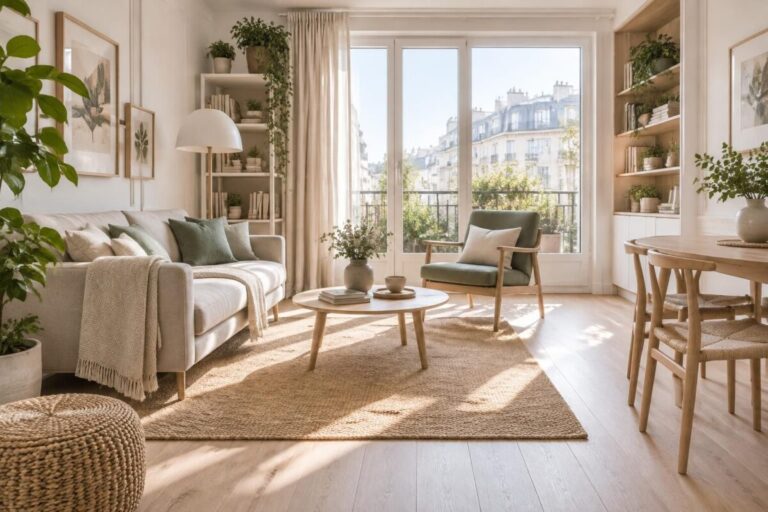
Moving some furniture away from the walls isn’t enough if the room still feels cluttered. To get small-space decorating right, keep useful items within easy reach and reserve surfaces for things you truly like. A sufficiently large rug can also visually bring the sofa and armchairs together, while well-placed lighting adds depth.
A low piece of furniture, a vertical shelf, or a folding table can free up floor space without making the room feel impersonal. Materials and colors also play a role: a few coordinated shades and varied textures warm up the room without making it feel cluttered.
Avoid common mistakes without changing everything
Before buying a new piece of furniture, consider whether the problem is its position, its size, or the number of objects around it. Moving an armchair or removing a small table can sometimes make more difference than buying something new. It’s a simple way to improve your interior layout without major renovations.
To get started, clear the main walkways and change one item’s position. If moving a piece of furniture out makes you have to walk around more obstacles, move it closer to the wall or remove a secondary item. The best layout is one that remains comfortable when the room is in use, not just one that looks good in a photo.
Practical questions about furniture in a small space
Should you always pull furniture away from the walls?
No. A small gap can make a room feel more open, but furniture can stay against the wall if the walkway is narrow or its function requires it. Adapt the layout to the flow of movement and the room’s constraints.
How many centimeters should you leave behind a sofa?
There’s no universal distance. A few centimeters may be enough to soften the visual effect; above all, check access to outlets, ventilation, and the available space.
How can you save space without pushing all the furniture against the walls?
Get rid of furniture you rarely use, choose compact or multifunctional pieces, and keep the main walkways clear. A rug can define the living area without adding a partition.
What should you do if the space between a piece of furniture and the wall looks unattractive?
You can tuck a slim lamp, a suitable plant, or a narrow storage unit into the gap if there’s room. For a small gap that’s difficult to use, opt for a subtle finish rather than adding a bulky object.
Thanks for your interest; Olivia. P.S. I’d be delighted if you left me a comment at the end of the article.