
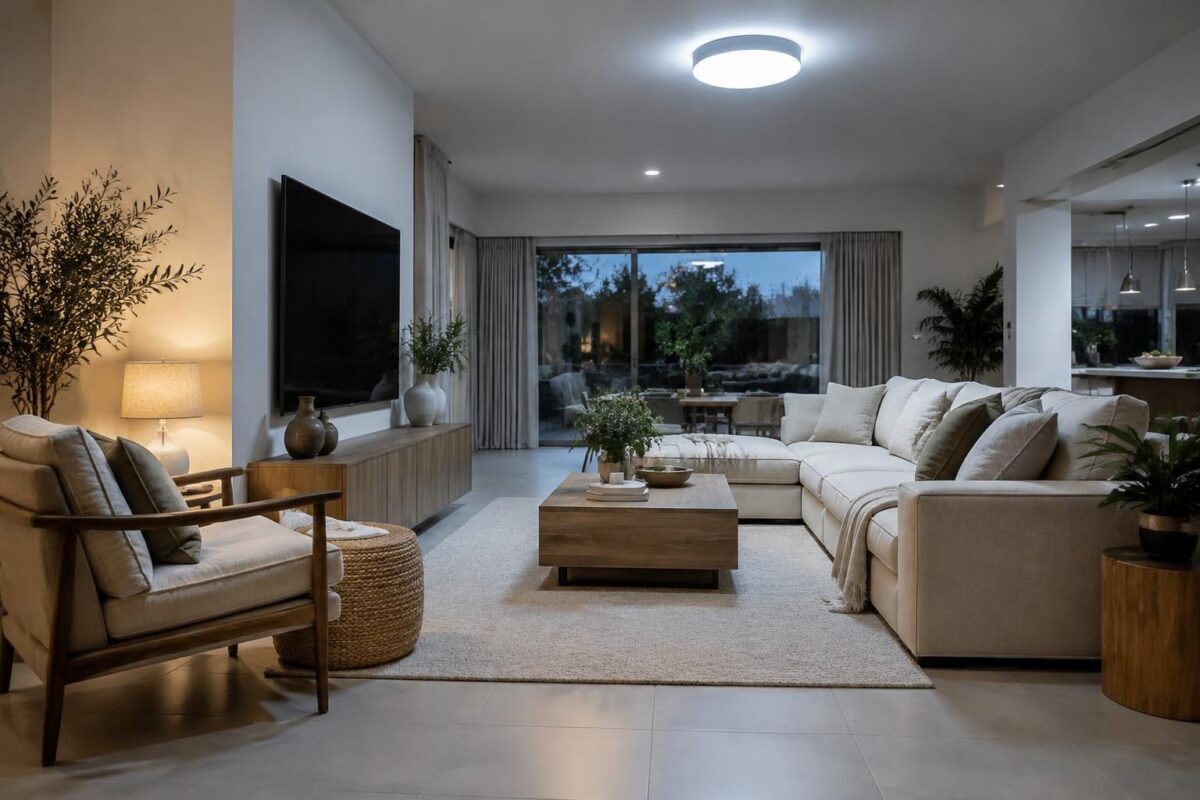
Interiors: Why White Light Works Against You
Hi, it’s Olivia. White light often works against you because it makes the atmosphere feel colder and accentuates contrasts. By choosing a color temperature better suited to each room, you can regain visual comfort without changing your entire interior decor. A few adjustments are all it takes to transform your indoor lighting.
Things to do right away
- Check the color temperature indicated on your light bulbs.
- Replace very cool bulbs in the living room and bedroom.
- Add a lamp rather than relying on a single ceiling light.
- Test the lighting in the evening, when the natural light has faded.
- Keep a more neutral light near work areas.
If your rooms also feel lacking in warmth, find out how to warm up a modern apartment and why lighting that’s too cool can affect your comfort.
Why white light makes a room feel colder
The trap is thinking that whiter light automatically makes a room brighter. On the contrary, it can create a clinical feel, make shadows harsher, and make the colors of walls or fabrics feel less welcoming.
The cause often comes down to color temperature, measured in kelvins (K). As a general guide, a bulb around 2,700 to 3,000 K produces warm light, while a shade around 4,000 K or higher appears cooler.
The right lighting depends on how you use the space
In a living room, warm light creates a cozy atmosphere and works well for relaxing. In a kitchen or workspace, more neutral light can help you see details without making the whole room feel cold.
LED lighting isn’t necessarily white or cool: it comes in a range of color temperatures. Check the packaging before you buy, then see how it looks in your home, since walls and materials affect how light is perceived.
Which color temperature to choose for each room
For example, Camille had installed the same white bulb in her entryway, kitchen, and living room. In the evening, her apartment felt uniform and unwelcoming; changing only the living room lighting was enough to make a real difference.
| Area | General guide | Desired effect |
|---|---|---|
| Living room and bedroom | 2,700 to 3,000 K | Relaxation and a soft atmosphere |
| Kitchen and bathroom | 3,000 to 4,000 K | Good visibility without excessive coolness |
| Office or work surface | About 3,500 to 4,000 K | Focus and precision |
These guidelines aren’t absolute rules: daylight, wall colors, and your habits matter too. For a balanced interior, it’s better to vary your light sources than to look for one perfect bulb.
The single-ceiling-light trap
A powerful ceiling light can illuminate the whole room, but it often creates flat lighting and strong shadows. Add a table lamp, a floor lamp, or indirect lighting to spread light at different heights.
This layering makes the lighting atmosphere more flexible and improves visual comfort. It also highlights natural materials, textiles, and the colors you’ve chosen for your decor.
Three steps to fix lighting that’s too white
- Find the source that’s bothering you. In the evening, identify the bulb that makes the room look the coldest.
- Choose a different look. Try warm light in areas meant for relaxing, or a neutral shade if you need precision.
- Add a lamp. Spread out the light sources and observe the result over a few evenings before making any further changes.
Lighting doesn’t need to be uniform to be effective. A few well-placed light sources can make a room more welcoming while maintaining good visibility.
Is white light always bad for an interior?
No. More neutral light can be useful for working or preparing meals. It often becomes less pleasant when it dominates rooms intended for relaxing.
What light should you choose for the living room?
A bulb around 2,700 to 3,000 K generally gives off a warm light. A lamp can soften the lighting even further.
Can an LED bulb produce warm light?
Yes. LED bulbs come in different color temperatures. Check the number of kelvins indicated on the packaging.
Do you need to replace all the bulbs in a room?
Not necessarily. Start with the source that bothers you most, then adjust the others if the overall effect still feels too cold or too uniform.
Thanks for reading! If this resonates with you, share your experience in the comments. — Olivia